Connecting Webflow
QuillJet connects to your Webflow site through the official Webflow Marketplace install. Once authorized, QuillJet registers webhooks for the triggers you choose and starts syncing new events into your email tool. This page covers install, which triggers a site listens to, enabling CMS triggers, pausing and resuming, reconnecting, and removing a site.
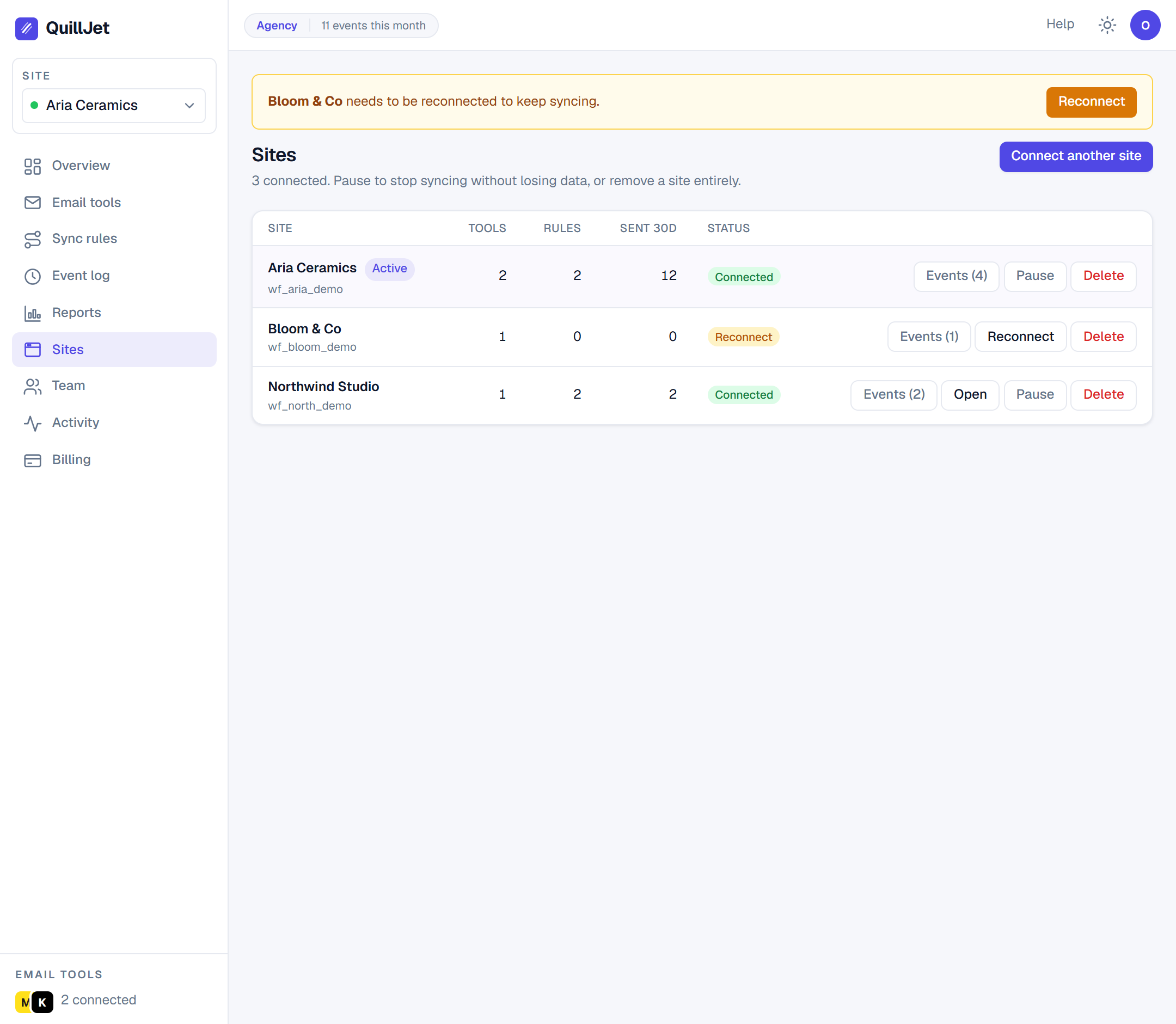
Install and authorize
Install QuillJet from the Webflow Marketplace and pick the site you want to sync. Webflow shows you the read scopes QuillJet requests, then hands back a token that QuillJet stores encrypted at rest.
QuillJet only ever asks for read access. It reads events from your site to build contacts. It never writes to your Webflow content.
After authorizing, QuillJet lists the site in the panel with its status. From there you can set triggers, connect an email tool, and build a sync rule.
Which triggers a site listens to
A trigger is the Webflow event QuillJet subscribes to. QuillJet supports five, each tied to a Webflow read scope:
| Trigger label | Scope needed | Group |
|---|---|---|
New order |
ecommerce:read |
Ecommerce |
Inventory changed |
ecommerce:read |
Ecommerce |
Form submission |
forms:read |
Forms |
CMS item created |
cms:read |
CMS |
CMS item updated |
cms:read |
CMS |
A freshly connected site listens to three triggers by default: New order, Inventory changed, and Form submission. You can turn any of these off, or turn CMS triggers on, from the site's trigger settings. QuillJet reconciles the live Webflow webhooks to match your selection, so only the triggers you choose will fire.
Enabling CMS triggers (needs re-authorize)
CMS item created and CMS item updated need the cms:read scope, which is not part of the default install. When you turn on a CMS trigger, QuillJet stores your choice right away, but it cannot register the webhook until your token carries cms:read.
The panel prompts you to re-authorize. After you approve the added scope, QuillJet registers the CMS webhooks automatically, and your stored selection activates without any further setup. Until you re-authorize, the CMS trigger stays saved but inactive.
Tip: If you enabled a CMS trigger but nothing is arriving, check that you completed the re-authorize step. The trigger can be selected yet still waiting on
cms:read.
Pausing and resuming a site
Pausing a site stops new events without losing anything. When you pause, QuillJet removes the Webflow webhooks it registered, but keeps every sync rule, email tool connection, and your full event history intact. While paused, incoming events are ignored and nothing new is captured.
Pausing is reversible. Any account member can pause or resume a site, since it is an operational action rather than a destructive one.
Reconnecting
Resuming a paused site (or one whose token has gone stale) uses reconnect. QuillJet first probes your stored Webflow token:
- If the token still works, QuillJet re-registers your webhooks and flips the site back to connected with no OAuth round trip.
- If the token is dead (revoked or missing a scope), QuillJet marks the site as needing re-authorization and sends you back through the Webflow authorize flow.
Reconnect after re-authorizing restores the exact triggers you had selected, including any CMS triggers you had turned on.
Removing a site
Removing a site is permanent. It deletes the site and everything scoped to it: its sync rules, its email tool connections, its stored events, and its deliveries all cascade away. QuillJet also unregisters the webhooks it created on Webflow as a best-effort cleanup.
Because it is destructive, only the account owner can remove a site. If you just want to stop syncing for a while, pause the site instead.
See connecting email tools next, then build a sync rule. For what happens after an event arrives, see how syncing works.